

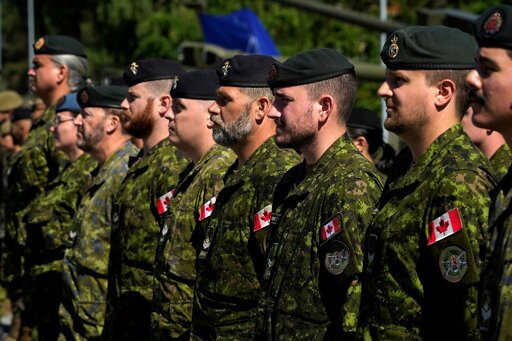
Captain Stephen Ye, commander of the defence and security platoon at the headquarters of the Labrie military base near Riga, is responsible for protecting the brigade headquarters. He says innovations in Russia’s war in Ukraine are continually reshaping his job.
“It has helped us understand that the battlefield we operate in is now almost completely transparent. It is very hard to hide when drones have become so widespread that perhaps there is no such thing as a safe zone anymore, so we must always think about security, no matter where we are operating,” Capt Ye tells LRT.lt.
At the base, troops from Canada’s lead multinational brigade train for a range of scenarios – from drone reconnaissance to enemy infiltration. Although they are trained to use various types of counter-drone weapons, NATO troops still lack their own unmanned aircraft to prepare effectively for modern drone warfare.
“As ground-based soldiers, we usually talk about the importance of overhead cover, but it has never been more important than it is now, with the proliferation of unmanned aerial systems all over the battlefield,” Capt Ye says.
…
Canada began its mission in Latvia in 2014 after Russia’s aggression against Ukraine. The operation was named Reassurance, reflecting NATO allies’ intent to reassure eastern flank members that the Alliance would defend them.
More than a decade on, the operation has become the largest overseas mission of the Canadian Armed Forces. During a visit to Riga this August, Canadian Prime Minister Mark Carney announced its extension for another three years.
Canada now deploys ships to the Baltic region, contributing to NATO’s standing naval forces and other missions. The country also maintains an air force unit providing logistical support from the United Kingdom.
Canada’s land forces established their presence in Latvia in 2017, when the country agreed to lead the multinational NATO battlegroup. After Russia’s full-scale invasion of Ukraine, the battlegroup was expanded to a brigade of several thousand troops.
…
The European Union and Canada also announced last Monday an agreement that will allow Ottawa to join SAFE, the EU’s €150-billion defence financing programme. The scheme aims to offer favourable loans to participating states so they can purchase weapons jointly with other partners.
…
As his six-month rotation draws to a close, Capt Ye is preparing to return to Canada. Reflecting on his service in Latvia, he says the sense of purpose and the experience gained outweigh all the challenges.
“Working with NATO allies is an opportunity I would not have had at home. Coming here and working with all these different countries has been challenging – because of language barriers, because of different command structures and so on. But that is also why I volunteered to come here: I wanted to get to know our NATO allies better and see what we can learn from them,” Capt Ye says.
Go Canada!