
Context: I recently learned that the commonly repeated claim that classic Greece and Rome was scientifically and technologically stagnant is not the historic consensus and has not been so for decades. It is a common knowledge today that no serious historian believes the middle ages to be stagnant but I feel the claim that Greece and Rome was technologically locked in time is still fairly prevalent, even in academic circles. Of course, among historians not specializing in the antique world.
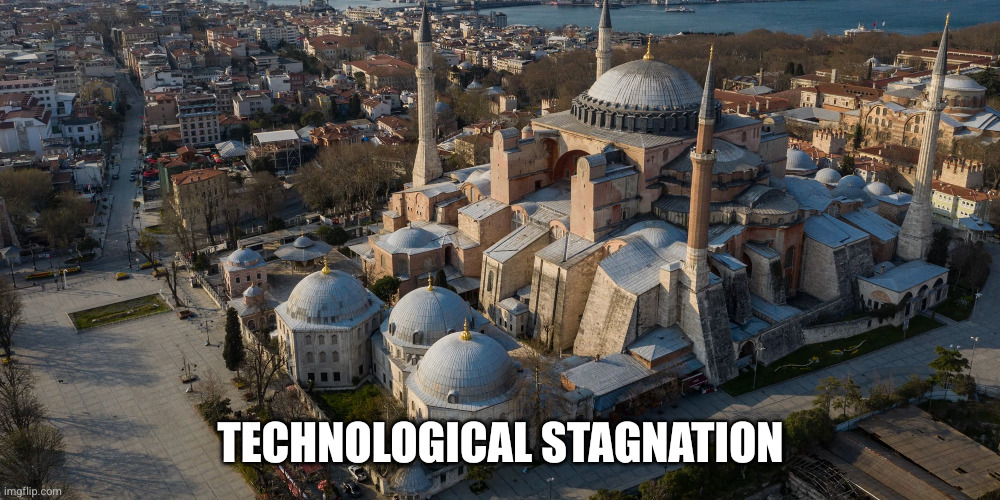
Architect: What percent of the walls are require to be orthogonal to the ground?
King: Huh?
Wait people think of Rome of all places as technologically stagnant‽ Sure they weren’t producing the wonders of China, but they were breaking ground in construction and metallurgy. The republic began with bronze spears in huts, and ended not long after the snapshot we have in Pompeii with aqueducts and steel. By the fall of the western empire (beginning of European middle ages), the equii of Caesar’s childhood had become more like knights (hell, cavalry was an early classical innovation, though Scythian not Greco-Roman).
And the medieval period picked up from there and ended with early clockwork, castles, plate armor, early firearms, cannons, and the spanish found America. This was a thousand years and each century was distinct in its cultural and technological position.
The actual point is that the periods are similar in advancement, with an edge to the medieval period if anything. If you damn the medieval period for stagnation you’re absolutely dunking on Romans spreading their advancements over literally a thousand years, or the Greeks and Persians getting their minds absolutely blown by the idea of “what if phalanxes, but with longer spears”
I’m no historian at all but when I think Middle Ages I think the progress of the Muslim world and, begrudgingly, the Catholic church’s role in supporting science (though that may have been later?).
The Islamic Golden Age has basically always been recognized as a light of civilization in a dark (ha) age. Talk of medieval ‘stagnation’ is usually in reference to Western Europe experiencing total civilizational collapse and the Byzantine Empire entering a long, slow decline.
And both of those things are true, mind you - they just didn’t result in any sort of period of stagnation where IGNORANCE RULED and SUPERSTITION WAS KING (at least no more than it was before). Europe almost immediately began after the fall of the Empire, as in every period, building on what they had in exciting, innovating ways. They just had… lost a lot of pillars of society’s more complex functions, and needed time to rebuild them.
My favorite comparison is always the Greek ‘Dark Age’ over a thousand years before. Greek material technology actually advanced quite considerably during the Greek Dark Age. But societal complexity had suffered from a near-total civilizational collapse so much that the actual, practical capabilities of Greek polities was reduced in spite of these innovations, and took hundreds of years to recover.
Recovery necessarily implies damage - but recovery is almost always dynamic and innovative as well.
commonly repeated claim that classic Greece and Rome was scientifically and technologically stagnant
First time I’ve heard about this TBH …
I mean there’s a more of a point there than there is to the medieval period when you look at it like that. The Islamic Golden Age leading into the the beginnings of the Renaissance alone outpaces mathematical innovation by everyone from Pythagoras to Hypatia.
Funny enough, there was a prevailing ‘countercurrent’ a few decades back that the decline and fall of the Roman Empire was neutral or beneficial to societal complexity in Western Europe in response to exaggerated perceptions of medieval ‘stagnation’. Pretty brutally rejected by archeology since the 1980s, but still pops up every now and again.
“We made a correction, but now must correct the correction” - all academia, forever
Time is a flat circle. We never learn. There must always be a scape goat.
Edit: it recently rose again with all those awful why couldn’t/what if Rome industrialized videos
Medieval monks spent a lot of time studying the stars and geometry while trying to discover God’s divine plan. Too bad many of the most devout Christians are so anti science nowadays.