You have a disappointing career until middle age, and then are going to blossom into one of the most famous and revered figures of your field of all time?
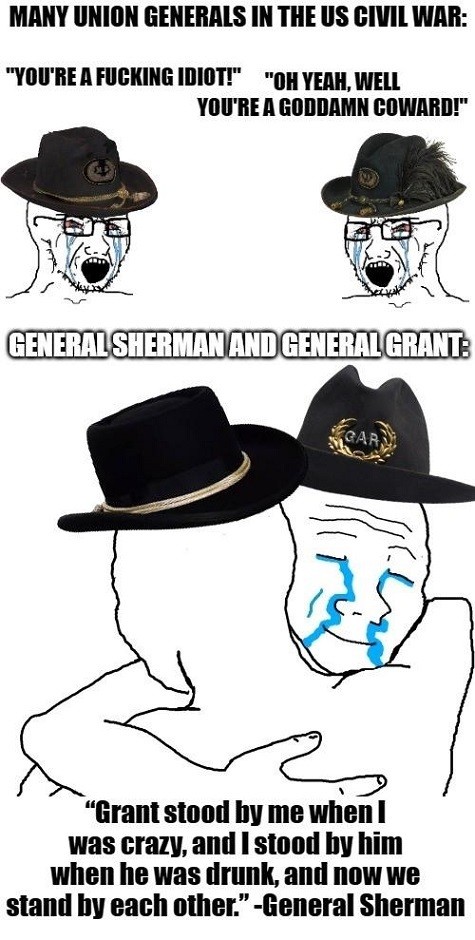
Funny enough, Grant’s drinking and Sherman’s insanity are often overplayed.
While Grant did retain some of the ‘party hardy’ in later life, his most infamous drinking was when he was separated from his wife and kids as a junior officer in the American West. He seemed to take separation from his family hard, and was famously, deeply in love with his wife. His drinking was pretty controlled outside of pretty safe and quiet periods after major successes in the Civil War, and he never drank heavily when his family was present - not because they didn’t know, but because he didn’t feel the need to.
Sherman was famously volatile, short-tempered, and sensitive, but his ‘insanity’ - as both the papers and he himself put it - was more of an acute stress-reaction-cum-depression. When he felt he had failed in some way, he could spiral into incredible depths of self-loathing, but didn’t display any real break with reality. Some have suggested that he might have had bipolar disorder, wherein weeks-long or months-long stretches of alternating hyperactivity and depression give an appearance of instability. This would also fit his claims of his strain of ‘insanity’ running in his family, as bipolar disorder has a strong genetic component.
Their careers were total wrecks at the time of the US Civil War.
Both had left the Army - Grant unwillingly (but to spare his family the shame of a court martial, even if he thought he could beat the charges), Sherman partially unwillingly. Grant had taken up farming, which he was not good at, and was immensely impoverished - even selling his watch to buy his family Christmas presents (Grant was always a family man). Sherman had initially entered into banking, which he was not good at, and was reliant on his father-in-law’s money. Sherman would later become a teacher for a military academy, teaching college-age kids, which he enjoyed more and was good at. It was in Louisiana, though, so when the war broke out, he, literally and openly sobbing, chose that his coremost loyalty lay with the USA, not the young men he taught or the fellow professors he had befriended.
Both Grant and Sherman re-entered the Army at the breakout of the Civil War with no great fanfare, as they had no real records to speak of. Sherman’s first command at Bull Run went so disastrously that he specifically requested to President Lincoln that in his next posting, he NOT be in command (something Lincoln regarded as a relief, since the US Army was fucking full of divas insisting they were to be in command).
Sherman was assigned under Grant in the Western theatre, which was considered ‘secondary’ to the Eastern theatre, and there, they both made military history, feeding off of each other’s opposed-yet-complimentary energy. Grant the calm, quiet, but straightforward and clear-sighted leader; Sherman the energetic, talkative, ambitious, and cunning planner.
People need the right circumstances to begin to shine.
You have a disappointing career until middle age, and then are going to blossom into one of the most famous and revered figures of your field of all time?
Funny enough, Grant’s drinking and Sherman’s insanity are often overplayed.
While Grant did retain some of the ‘party hardy’ in later life, his most infamous drinking was when he was separated from his wife and kids as a junior officer in the American West. He seemed to take separation from his family hard, and was famously, deeply in love with his wife. His drinking was pretty controlled outside of pretty safe and quiet periods after major successes in the Civil War, and he never drank heavily when his family was present - not because they didn’t know, but because he didn’t feel the need to.
Sherman was famously volatile, short-tempered, and sensitive, but his ‘insanity’ - as both the papers and he himself put it - was more of an acute stress-reaction-cum-depression. When he felt he had failed in some way, he could spiral into incredible depths of self-loathing, but didn’t display any real break with reality. Some have suggested that he might have had bipolar disorder, wherein weeks-long or months-long stretches of alternating hyperactivity and depression give an appearance of instability. This would also fit his claims of his strain of ‘insanity’ running in his family, as bipolar disorder has a strong genetic component.
Damn. The “most famous and revered figures” part remains to be seen, but otherwise, that’s scary dead-on.
Their careers were total wrecks at the time of the US Civil War.
Both had left the Army - Grant unwillingly (but to spare his family the shame of a court martial, even if he thought he could beat the charges), Sherman partially unwillingly. Grant had taken up farming, which he was not good at, and was immensely impoverished - even selling his watch to buy his family Christmas presents (Grant was always a family man). Sherman had initially entered into banking, which he was not good at, and was reliant on his father-in-law’s money. Sherman would later become a teacher for a military academy, teaching college-age kids, which he enjoyed more and was good at. It was in Louisiana, though, so when the war broke out, he, literally and openly sobbing, chose that his coremost loyalty lay with the USA, not the young men he taught or the fellow professors he had befriended.
Both Grant and Sherman re-entered the Army at the breakout of the Civil War with no great fanfare, as they had no real records to speak of. Sherman’s first command at Bull Run went so disastrously that he specifically requested to President Lincoln that in his next posting, he NOT be in command (something Lincoln regarded as a relief, since the US Army was fucking full of divas insisting they were to be in command).
Sherman was assigned under Grant in the Western theatre, which was considered ‘secondary’ to the Eastern theatre, and there, they both made military history, feeding off of each other’s opposed-yet-complimentary energy. Grant the calm, quiet, but straightforward and clear-sighted leader; Sherman the energetic, talkative, ambitious, and cunning planner.
People need the right circumstances to begin to shine.