Dunno if I agree with either interpretation there. Many long-suffering polities are intensely conservative, while many of the least-conservative polities have arisen out of long periods of peace.
I suspect, meme aside, that it has less to do with suffering and more to do civic participation. Mexico, since multi-party democracy in the 90s, has enjoyed a very high degree of civic participation, despite its troubles, pushing it towards (relative) trust in the process of government (if not necessarily the current government itself) to resolve problems. Countries with low civic participation end up with the opposite problem - people feel helpless to influence the government, and turn to other - almost invariably less trustworthy institutions (like religious orgs, private charities, local clientistic power structures, corporations/‘the market’, etc) - to leverage against their problems. Which is less effective, but they feel more involved in it.
I think it’s more that in countries without major social upheaval, power becomes concentrated and centralized. The lack of social upheaval allows the powerful to maintain power without overt use of force. Also, when people from those countries compare their lives to people in chaotic and violent countries, they can be made to think that a conservative system where a select few hold wealth and power is better than chaos.
On the other hand, when there’s a struggle for power, upheaval, disorder, etc. the wealthy have to use violence to maintain their hold. That opens up opportunities for socialist or communist voices to say that it doesn’t have to be like this, and that the rich have no right to use violence to maintain their power and wealth.

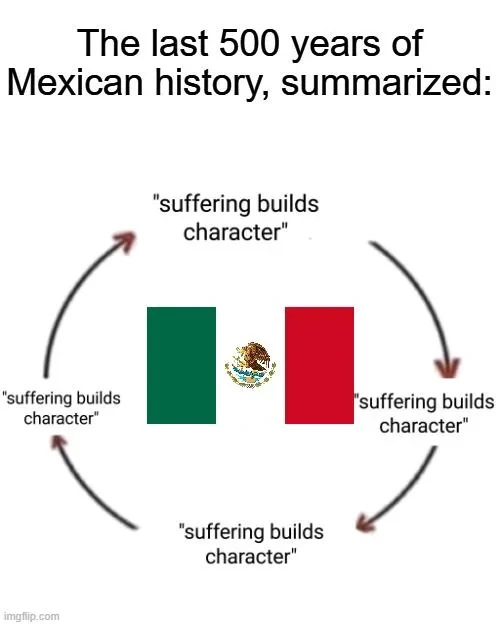
Ever notice how when a country or region suffers more and longer, the more socially minded they become?
Conversely, the more comfortable and untroubled a nation or region is, the more conservative and unstable it becomes over time.
Dunno if I agree with either interpretation there. Many long-suffering polities are intensely conservative, while many of the least-conservative polities have arisen out of long periods of peace.
I suspect, meme aside, that it has less to do with suffering and more to do civic participation. Mexico, since multi-party democracy in the 90s, has enjoyed a very high degree of civic participation, despite its troubles, pushing it towards (relative) trust in the process of government (if not necessarily the current government itself) to resolve problems. Countries with low civic participation end up with the opposite problem - people feel helpless to influence the government, and turn to other - almost invariably less trustworthy institutions (like religious orgs, private charities, local clientistic power structures, corporations/‘the market’, etc) - to leverage against their problems. Which is less effective, but they feel more involved in it.
This person governments
I think it’s more that in countries without major social upheaval, power becomes concentrated and centralized. The lack of social upheaval allows the powerful to maintain power without overt use of force. Also, when people from those countries compare their lives to people in chaotic and violent countries, they can be made to think that a conservative system where a select few hold wealth and power is better than chaos.
On the other hand, when there’s a struggle for power, upheaval, disorder, etc. the wealthy have to use violence to maintain their hold. That opens up opportunities for socialist or communist voices to say that it doesn’t have to be like this, and that the rich have no right to use violence to maintain their power and wealth.