

You must log in or # to comment.
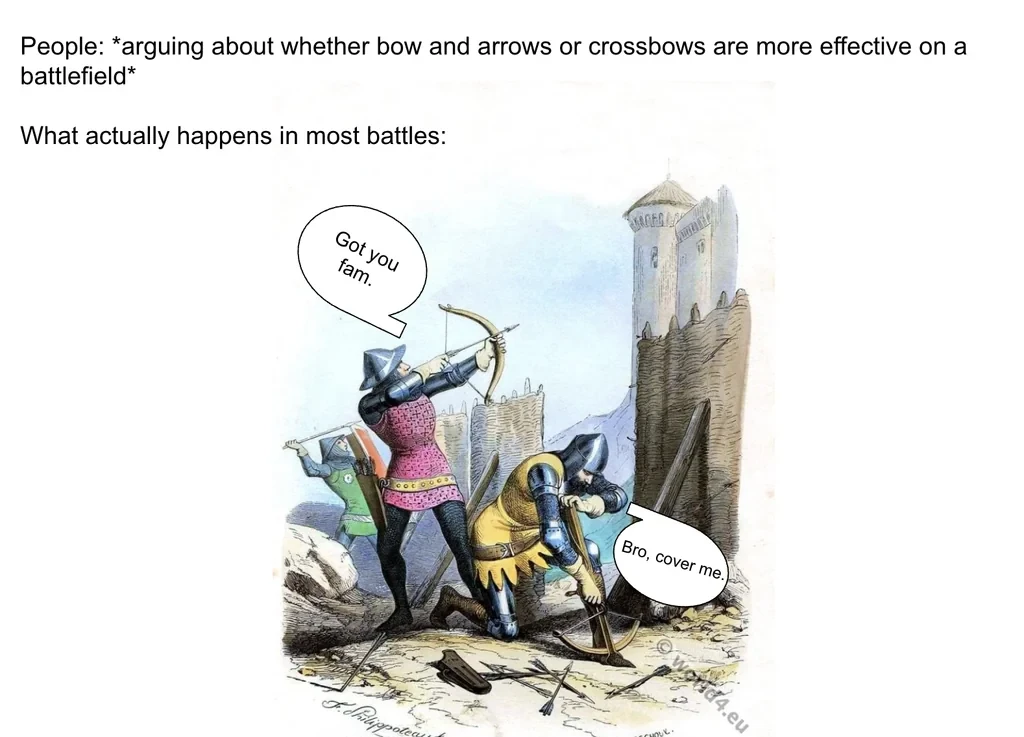
Explanation: A common topic of debate for medieval history enthusiasts is the superiority of the bow or crossbow over each other.
In practice, the two were widely used together in armies. I’m reminded of a 13th or 14th century part-time London mercenary who owned both a shortbow (as the tradition of the longbow was still developing in England) and a crossbow.
Now, full disclosure beforehand - I love the crossbow much more. I fucking love CIVILIZATION, I love ENGINEERING, I love PROFESSIONAL SOLDIERS
But it was seen as much less of a ‘choice’ of which was superior and more a question of which was available. As the medieval period wore on, the crossbow became preferred for war due to increasing technological refinement increasing power and fire rate, but well into the gunpowder age, very often requirements for vassal call-ups was to equip an archer or crossbowman, rather than a stark demand for one or the other. Clearly, the distinction was not vital for the purposes of most feudal armies. Mercenary groups and some city militias sometimes made demands of one or the other - typically of the crossbow, which was easier to learn and more useful in sieges (besieged or besieging) - but most polities simply required a certain percentage of troops able to harry the enemy at range.
The crossbow, as a more mechanically complex and expensive weapon, was common amongst urban militias (typically made of moderately prosperous artisans) and professional soldiers (who could learn the use of the weapon upon taking up the often-not-respected career of a mercenary), as well as being peerless as a weapon for the defense of castles (due to the ability to aim for a prolonged period without straining the soldier). The bow, as a simpler weapon which requires regular use to be proficient in, but has fairly low maintenance requirements, was more common as the weapon of levies and rural militia, who would use the weapon to hunt for game (rabbits and the like legally; larger game often illegally).
The English use of the longbow - starting in the 13th century AD, but taking some time to become fully established - is a rare exception to the generally lackadaisical “either/or” enforced by most feudal polities of the period. The English use of the longbow required a vast swathe of England to be mandated to train with the weapon regularly, even in peacetime, just to maintain a body of men with the requisite expertise - not always an easy demand to enforce.